动词A1
Regelmäßige Verbkonjugation
Conjugating regular verbs like heißen, kommen
学习目标
Can introduce themselves using simple present tense verbs
考试技能:写作口语
观察以下示例,你能发现语法规律吗?
Ich heiße Anna.
My name is Anna.
Woher kommst du?
Where do you come from?
Wir lernen Deutsch.
We are learning German.
注意高亮部分,它们有什么共同点?
English verbs barely change in the present: I play, you play, we play, and just "he plays" gets an ending. German puts an ending on every person, and the ending tells you who is acting. Most verbs are regular and follow one pattern, so learning it once unlocks hundreds of verbs.
Stem plus ending
Take the infinitive, remove -en, and you have the stem: kommen → komm-, machen → mach-. Then add the endings:
| Person | Ending | kommen (to come) | machen (to do, make) |
|---|---|---|---|
| ich | -e | komme | mache |
| du | -st | kommst | machst |
| er/sie/es | -t | kommt | macht |
| wir | -en | kommen | machen |
| ihr | -t | kommt | macht |
| sie/Sie | -en | kommen | machen |
Two shortcuts: the wir and sie/Sie forms look like the infinitive, and the er and ihr forms share the ending -t. What you really have to learn is -e for "I" and -st for "you".
One German form, three English ones
German has no "-ing" present and no "do" in questions. Ich koche covers "I cook", "I am cooking" and, in a question, "do I cook". Was machst du? means both "What do you do?" and "What are you doing?" Translating "I am cooking" word for word as *Ich bin kochen is a typical beginner's error. The present also handles the near future: Morgen kaufe ich ein Dirndl. - Tomorrow I'm buying a dirndl.
Common regular verbs
| Verb | er/sie/es | Verb | er/sie/es |
|---|---|---|---|
| wohnen (to live) | wohnt | lernen (to learn) | lernt |
| spielen (to play) | spielt | kaufen (to buy) | kauft |
| fragen (to ask) | fragt | hören (to hear) | hört |
| sagen (to say) | sagt | suchen (to look for) | sucht |
| brauchen (to need) | braucht | kochen (to cook) | kocht |
| zeigen (to show) | zeigt | lieben (to love) | liebt |
| reisen (to travel) | reist | tanzen (to dance) | tanzt |
| arbeiten (to work) | arbeitet | warten (to wait) | wartet |
| öffnen (to open) | öffnet | reden (to talk) | redet |
The last two rows show the one wrinkle: a stem ending in -t, -d or a cluster like -fn takes an extra -e- so you can pronounce it: er arbeitet, du wartest. With reisen and tanzen, whose stems end in an s-sound, the du form adds just -t: du reist, du tanzt.
在 A1 课程练习中应用此语法
练习题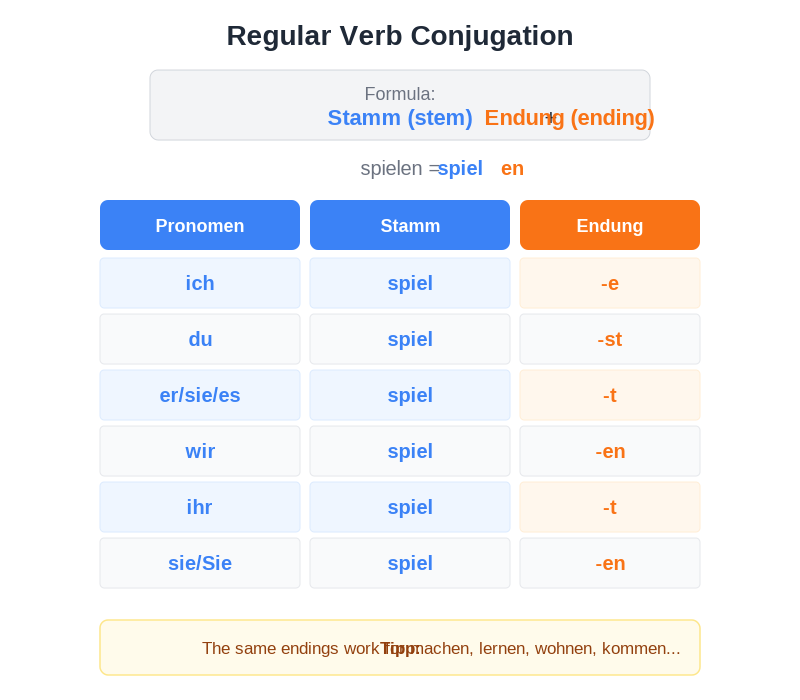
Learners forget the -st ending for du or use -s (English influence). It's du kommst, not du komms.
🇬🇧 English speakers: English speakers add -s for third person (like English 'he comes') instead of the German -t ending, or drop endings altogether.
Ich heiße Anna.
My name is Anna.
heißen: ich heiße — the ß counts as a double consonant, stem heiß + -e.
Woher kommst du?
Where do you come from?
kommen: du kommst — stem komm + ending -st.
Wir lernen Deutsch.
We are learning German.
lernen: wir lernen — the wir-form is identical to the infinitive.
这个主题的检测还在准备中
问问索菲
在课程中练习
在 A1 课程练习中应用此语法