Động từA2
Předpony u sloves pohybu
Spatial prefixes on motion verbs: při- (arrival), od- (leaving), vy- (out), pře- (across), v- (in) — and why prefixed forms are perfective
Mục tiêu học tập
I can express arriving, leaving, crossing and entering with prefixed motion verbs in past and future.
Kỹ năng thi cử:CCE A2 · NgheCCE A2 · Nói
Hãy xem các ví dụ sau. Bạn có nhận ra quy tắc ngữ pháp không?
Rychlík z Ostravy přijede na třetí kolej.
The express from Ostrava will arrive on track three.
Odešla z kanceláře v pět a vyšla na Petřín.
She left the office at five and walked up Petřín hill.
Přejděte most a vejděte do první hospody.
Cross the bridge and enter the first pub.
Chú ý các phần được đánh dấu. Chúng có điểm gì chung?
English builds direction with a little word after the verb: come in, go out, walk across. Czech puts that little word in front, as a prefix, on jít (on foot) or jet (by vehicle). The prefix also makes the verb perfective: one completed movement.
The main prefixes
| Prefix | Direction | On foot | By vehicle |
|---|---|---|---|
| při- | arriving | přijít | přijet |
| od- | leaving | odejít | odjet |
| v(e)- | in | vejít | vjet |
| vy- | out; up | vyjít | vyjet |
| pře- | across | přejít | přejet |
| ob(e)- | around | obejít | objet |
| do- | as far as | dojít | dojet |
| s(e)- | down | sejít | sjet |
A few more you will hear daily: projít (go through; a walk is a procházka), zajít (pop in: Zajdeme na pivo?), and ujet, which gives the most Czech of excuses: Ujela mi tramvaj, I missed the tram.
Perfective, so no budu
Because these verbs are perfective, their present-tense forms mean the future: přijdu (I'll come), přijedu (I'll arrive), odejdu (I'll leave). *Budu přijít does not exist. The past is regular: přišel, odešel, přijel, odjel.
For the ongoing or repeated movement each verb has an imperfective partner built on -cházet (foot) or -jíždět (vehicle): přicházet, odcházet, vycházet; přijíždět, odjíždět, vyjíždět. On the platform you hear Vlak z Brna právě přijíždí. One of these has its own life: dojíždět means to commute. Dojíždím do Prahy z Kladna.
Where English speakers slip
- "Come" is not always přijít. A train, a bus or a friend driving over přijede: Rychlík z Ostravy přijede v deset. If you walk, přijdu.
- Adding a preposition English does not need. Czech often repeats the direction: vejít do domu, vyjít z domu, odejít z práce.
- Reading vy- as only "out". With a hill it means up: Vyšli jsme na Petřín.
Some prefixed verbs carry a second meaning worth knowing early: přejet stanici is to ride past your stop, and sejít se is to meet. Prague's classic meeting point is under the statue of St Wenceslas: Sejdeme se u koně.
Áp dụng ngữ pháp này vào các bài tập khóa học A2
Bài tập thực hành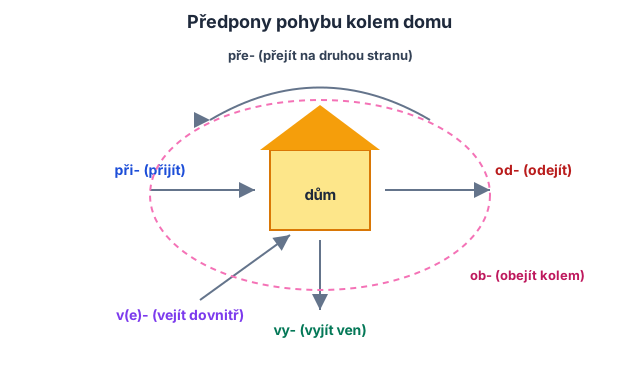
- Prefixed perfectives with budu: *budu přijít → přijdu
- A foot verb for a vehicle: Vlak *přijde → přijede (trains arrive with -jet)
- od- vs vy-: odejít z práce (leave) × vyjít z domu (step out)
Rychlík z Ostravy přijede na třetí kolej.
The express from Ostrava will arrive on track three.
přijede: arrival by vehicle, perfective future.
Odešla z kanceláře v pět a vyšla na Petřín.
She left the office at five and walked up Petřín hill.
od- = away from, vy- = up/out: two directions, one sentence.
Přejděte most a vejděte do první hospody.
Cross the bridge and enter the first pub.
pře- = across, v(e)- = into; imperatives of prefixed verbs.
Bài kiểm tra cho chủ đề này đang được chuẩn bị
Hỏi Sofi
Luyện tập trong khóa học
Áp dụng ngữ pháp này vào các bài tập khóa học A2