Động từA2
Slovesa pohybu – jít/jet, chodit/jezdit
Determinate vs indeterminate motion: jít/jet for one direction now, chodit/jezdit for habits, plus the futures půjdu/pojedu
Mục tiêu học tập
I can distinguish one-way and habitual motion on foot or by vehicle and form the futures půjdu and pojedu.
Kỹ năng thi cử:CCE A2 · NgheCCE A2 · Nói
Hãy xem các ví dụ sau. Bạn có nhận ra quy tắc ngữ pháp không?
Každou neděli chodíme s dětmi na Petřín.
Every Sunday we go with the children to Petřín hill.
Teď nemůžu mluvit, jedu tramvají na nádraží.
I can't talk now, I'm on the tram to the station.
V létě pojedeme na Moravu a půjdeme na vinobraní.
In the summer we will travel to Moravia and go to the wine harvest festival.
Chú ý các phần được đánh dấu. Chúng có điểm gì chung?
English "go" covers walking to the shop, taking the train to Brno and flying to London. Czech splits it twice: by how you travel, on foot or by vehicle, and by whether you mean one trip in one direction or going regularly.
| one trip, one direction | regularly, there and back | |
|---|---|---|
| on foot | jít (jdu, šel) | chodit (chodím, chodil) |
| by vehicle | jet (jedu, jel) | jezdit (jezdím, jezdil) |
| flying | letět (letím) | létat (létám) |
| running | běžet (běžím) | běhat (běhám) |
| carrying | nést (nesu) | nosit (nosím) |
Jdu do práce - I'm on my way to work. Chodím do práce pěšky - I walk to work (as a rule). Jedu tramvají na nádraží - I'm on the tram to the station. Každý pátek jezdíme na chalupu - Every Friday we go to the cottage. Každou neděli chodíme na Petřín.
Feet or wheels?
Anything on wheels or rails takes jet / jezdit, and so do bikes and skis: jet na kole, jezdit na lyžích. So it is Jedu autobusem, not *Jdu autobusem. But for going out to something in town, Czech often keeps jít even if you take the tram, because the outing matters, not the transport: Jdeme do kina. Půjdeš s námi na koncert? When the journey itself is the point, especially out of town, use jet: V sobotu jedeme do Kutné Hory.
Future and past
Jít and jet form the future only with a prefix: půjdu, pojedu; *budu jít and *budu jet are not Czech. The other one-trip verbs usually do the same (poletím, poběžím, ponesu), but here budu is also standard: Budeme letět přes Vídeň, "we'll be flying via Vienna". The regular verbs take budu like any imperfective: Od září budu chodit na kurz češtiny. V zimě budeme jezdit na hory.
In the past, "I went to Brno yesterday" is usually Včera jsem byl v Brně if you are back, and Včera jsem jel do Brna if the trip is the news. Jezdil jsem do Brna means you used to go there.
Prefixes add a direction
With a prefix you get a perfective verb that says where: přijít (arrive), odejít (leave), vejít (go in), přijet (arrive by vehicle), odjet (drive off). These form the future normally, with no po-: Přijdu v sedm. Odjedeme v neděli ráno.
Beyond walking
Chodit also means attending (Dcera chodí do třetí třídy) and dating (Chodí spolu od jara). Jít turns up in everyday phrases with no movement at all: Jak to jde? (How's it going?), O co jde? (What's it about?).
Áp dụng ngữ pháp này vào các bài tập khóa học A2
Bài tập thực hành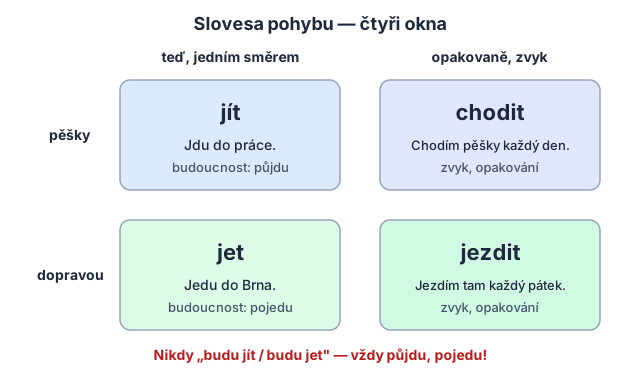
- *budu jít → půjdu; *budu jet → pojedu
- jít used for vehicles: *jdu autobusem → jedu autobusem
- One-way verb for habits: *Jdu do práce každý den → Chodím do práce každý den
Každou neděli chodíme s dětmi na Petřín.
Every Sunday we go with the children to Petřín hill.
Habit (každou neděli) → chodit, the indeterminate verb.
Teď nemůžu mluvit, jedu tramvají na nádraží.
I can't talk now, I'm on the tram to the station.
One direction right now, by vehicle → jet: jedu tramvají.
V létě pojedeme na Moravu a půjdeme na vinobraní.
In the summer we will travel to Moravia and go to the wine harvest festival.
Futures without budu: pojedeme (by vehicle), půjdeme (go, attend).
Bài kiểm tra cho chủ đề này đang được chuẩn bị
Hỏi Sofi
Luyện tập trong khóa học
Áp dụng ngữ pháp này vào các bài tập khóa học A2