动词A1
Imperativ (du-Form)
Informal commands: Geh! Nimm! Lies!
学习目标
Can give informal commands to friends and family
考试技能:写作口语
观察以下示例,你能发现语法规律吗?
Komm schnell!
Come quickly!
Lies das Buch!
Read the book!
Steh bitte auf!
Please stand up!
注意高亮部分,它们有什么共同点?
With friends, family and children, you give instructions with the du imperative. It is short and direct, and it has no pronoun, just like English "Come!" or "Read it!".
How to form it: start from the du form of the present tense, drop du, and drop the -st ending.
| Infinitive | du form | Imperative | English |
|---|---|---|---|
| kommen | du kommst | Komm! | Come! |
| gehen | du gehst | Geh! | Go! |
| machen | du machst | Mach! | Do it! |
| warten | du wartest | Warte! | Wait! |
Verbs whose stem ends in -t or -d keep an -e so the word can be pronounced: Warte! Rede! With other verbs an -e is possible but sounds old-fashioned or formal: Komme! is rare in speech.
Stem changes: e stays changed, a does not
| Change in the du form | Imperative | Example |
|---|---|---|
| e → i / ie (du nimmst, du liest) | keeps the change | Nimm! Lies! Sprich! Iss! Gib! |
| a → ä (du fährst, du schläfst) | loses the umlaut | Fahr! Schlaf! Lauf! |
So *Fähr! and *Nehm! are both wrong, in opposite directions. Sein is irregular: Sei leise! - Be quiet!
Separable verbs
The prefix goes to the end: Steh auf! - Get up! Mach das Licht an! - Turn the light on! Ruf mich morgen an! - Call me tomorrow!
Sounding friendly, not bossy
English speakers sometimes add the pronoun (*Komm du!) or assume the bare form sounds rude. Among friends it does not, especially with a small softener: Komm mal her! Nimm doch noch ein Stück Kuchen! - Go on, have another piece of cake. And bitte works here too: Steh bitte auf!
在 A1 课程练习中应用此语法
练习题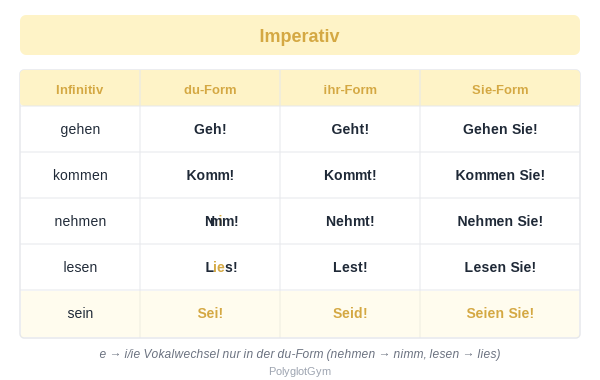
Learners include du or add umlaut for a→ä verbs: Fähr! is wrong — it's Fahr! Only e→i/ie changes are kept.
🇬🇧 English speakers: English speakers may include the pronoun: 'Komm du!' instead of 'Komm!' — the du-imperative drops the pronoun entirely.
Komm schnell!
Come quickly!
Regular verb: stem komm without du or ending -st.
Lies das Buch!
Read the book!
lesen: e → ie change is kept in the imperative: Lies!
Steh bitte auf!
Please stand up!
Separable verb aufstehen: Steh...auf! Prefix goes to the end.
这个主题的检测还在准备中
问问索菲
在课程中练习
在 A1 课程练习中应用此语法