动词A1
Stammvokaländerung
Stem-changing verbs: fahren→fährt, lesen→liest
学习目标
Can use common stem-changing verbs in conversation
考试技能:写作口语
观察以下示例,你能发现语法规律吗?
Er fährt morgen nach München.
He is driving to Munich tomorrow.
Sprichst du Deutsch?
Do you speak German?
Sie liest gern Romane.
She likes reading novels.
注意高亮部分,它们有什么共同点?
Some of the most frequent German verbs change their vowel in two persons of the present tense: du and er/sie/es. Everything else about them is regular. English has nothing like this in the present tense, so the forms have to be learned verb by verb, but there are four patterns and a short list of verbs to know at A1.
| Change | Infinitive | du | er/sie/es | English |
|---|---|---|---|---|
| a → ä | fahren | fährst | fährt | to drive, go |
| schlafen | schläfst | schläft | to sleep | |
| tragen | trägst | trägt | to carry, wear | |
| au → äu | laufen | läufst | läuft | to run, walk |
| e → i | sprechen | sprichst | spricht | to speak |
| essen | isst | isst | to eat | |
| helfen | hilfst | hilft | to help | |
| nehmen | nimmst | nimmt | to take | |
| e → ie | lesen | liest | liest | to read |
| sehen | siehst | sieht | to see |
Two persons change, four stay
The vowel changes in the du and er/sie/es forms. Ich, wir, ihr and sie/Sie keep the vowel of the infinitive: ich fahre, du fährst, er fährt, wir fahren, ihr fahrt, sie fahren. A frequent overcorrection is *ihr fährt or *ich spriche. Say the full row aloud a few times and the pattern settles.
Why the umlaut matters
Er fährt nach München and Er fahrt nach München sound different to a German ear, and the second is simply wrong. The same goes for er liest (he reads) against *er lest. Listen for the vowel: fährt has the sound of English "air", liest the "ee" of "least".
Note nehmen and essen
Nehmen changes more than its vowel: du nimmst, er nimmt. In essen, the du and er forms are identical: du isst, er isst, because the s-sound of the stem swallows the s of the ending. Ordering at a Viennese café: Ich nehme eine Melange, und meine Frau nimmt einen Apfelstrudel.
How to recognise them
Nothing in the infinitive warns you; machen and fahren look alike. Dictionaries and verb tables list the third person: fahren (fährt). Learn these verbs as a trio: fahren - du fährst - er fährt.
在 A1 课程练习中应用此语法
练习题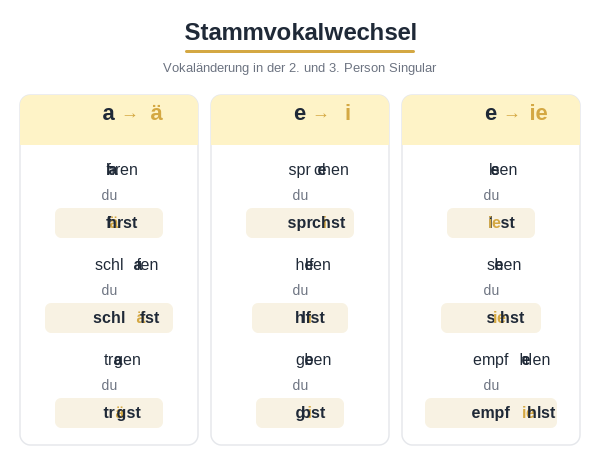
Learners apply the vowel change to all forms: wir fähren instead of wir fahren. Only du and er/sie/es change.
🇬🇧 English speakers: English speakers may apply the vowel change to all persons since English irregular verbs change the stem throughout (drive/drove).
Er fährt morgen nach München.
He is driving to Munich tomorrow.
fahren: a → ä in the er-form: er fährt.
Sprichst du Deutsch?
Do you speak German?
sprechen: e → i in the du-form: du sprichst.
Sie liest gern Romane.
She likes reading novels.
lesen: e → ie in the er/sie-form: sie liest.
这个主题的检测还在准备中
问问索菲
在课程中练习
在 A1 课程练习中应用此语法