动词A1
Trennbare Verben im Kontext
Separable verbs in shopping and daily contexts
学习目标
Can use separable verbs in shopping and daily life
考试技能:写作口语
观察以下示例,你能发现语法规律吗?
Ich probiere den Pullover an.
I am trying on the sweater.
Gibst du das Buch zurück?
Are you returning the book?
Wir nehmen die Kinder mit.
We are taking the children along.
注意高亮部分,它们有什么共同点?
English has phrasal verbs like "try on" and "give back", and the little word often wanders to the end: "Try the jacket on." German separable verbs feel similar, but the rules are stricter: in a normal main clause the prefix goes to the very end of the clause, however long it is.
| Verb | Meaning | Example |
|---|---|---|
| anprobieren | try on | Ich probiere die Jacke an. - I'm trying on the jacket. |
| ausgeben | spend (money) | Er gibt viel Geld für Sneaker aus. - He spends a lot on trainers. |
| mitnehmen | take along | Nimmst du eine Tasche mit? - Are you taking a bag? |
| zurückgeben | give back, return | Ich gebe die Pfandflaschen zurück. - I'm returning the deposit bottles. |
| einkaufen | do the shopping | Wir kaufen am Samstag ein. - We do our shopping on Saturday. |
The same verb in four sentence types
| Sentence type | Example | What happens |
|---|---|---|
| Statement | Ich probiere den Pullover an. | verb in position 2, prefix at the end |
| Question | Probierst du den Pullover an? | verb first, prefix still at the end |
| With a modal | Ich möchte den Pullover anprobieren. | infinitive at the end, written as one word |
| After weil | ..., weil ich den Pullover anprobiere. | verb at the end, prefix and verb join up again |
English speakers tend to keep the verb in one piece, as in *Ich anprobiere die Jacke, because "try on" looks like it should stay together. Train your ear on the gap: in Ich gebe das Buch morgen in der Stadtbibliothek zurück, the zurück only arrives after six words, and Germans wait for it.
How to spot one: the prefix carries the stress (ANprobieren, MITnehmen), and dictionaries mark the break with a bar or dot: an|probieren.
在 A1 课程练习中应用此语法
练习题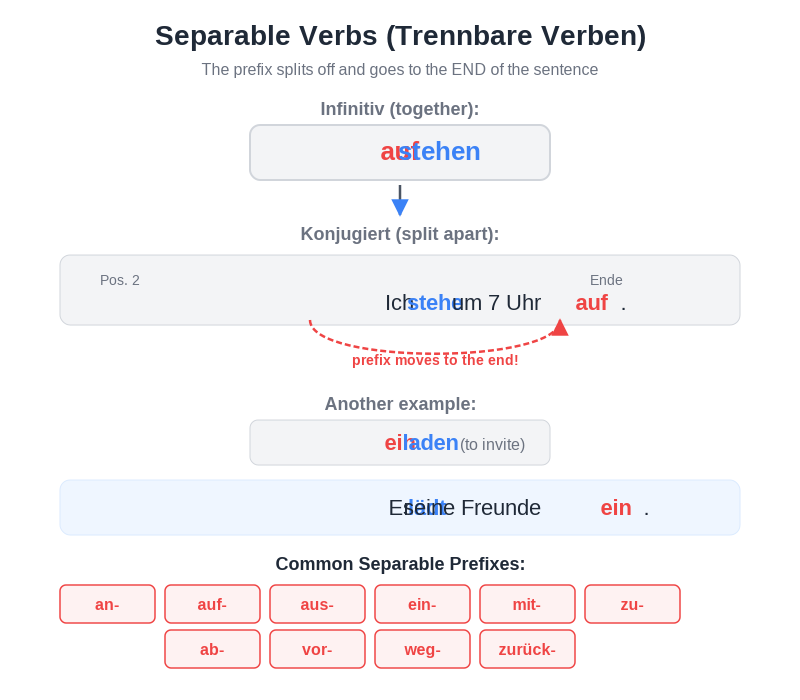
Learners forget to separate the prefix in daily speech or put it in the wrong position: Ich anprobiere instead of Ich probiere an.
🇬🇧 English speakers: English speakers have no equivalent of prefix separation and may keep the verb together: 'Ich anprobiere' instead of 'Ich probiere an'.
Ich probiere den Pullover an.
I am trying on the sweater.
anprobieren: the prefix an goes to the end.
Gibst du das Buch zurück?
Are you returning the book?
zurückgeben: zurück goes to the end, stem change e → i.
Wir nehmen die Kinder mit.
We are taking the children along.
mitnehmen: mit goes to the end.
这个主题的检测还在准备中
问问索菲
在课程中练习
在 A1 课程练习中应用此语法