动词A1
Imperativ (Sie-Form)
Formal commands: Gehen Sie! Nehmen Sie!
学习目标
Can give formal instructions and commands
考试技能:写作口语
观察以下示例,你能发现语法规律吗?
Nehmen Sie bitte Platz!
Please take a seat!
Gehen Sie geradeaus und dann links.
Go straight ahead and then left.
Rufen Sie mich morgen an!
Call me tomorrow!
注意高亮部分,它们有什么共同点?
When you tell a stranger, a customer or your doctor to do something, you use the Sie imperative. It is how instructions are given at a train station, in a shop, on a form - anywhere people say Sie to each other.
How to form it: take the infinitive, put it first, and follow it with Sie.
| Infinitive | Imperative | English |
|---|---|---|
| kommen | Kommen Sie herein! | Come in! |
| nehmen | Nehmen Sie bitte Platz! | Please take a seat. |
| gehen | Gehen Sie geradeaus und dann links. | Go straight on and then left. |
| warten | Warten Sie bitte hier! | Please wait here. |
| sein | Seien Sie bitte pünktlich! | Please be on time. |
The one irregular form is sein: the imperative is Seien Sie, not *Sind Sie.
Don't drop the Sie
English imperatives have no pronoun: "Come in!", "Wait here!". So English speakers tend to say *Kommen! or *Warten bitte!. In the Sie form the pronoun is part of the command. Without it, Kommen! sounds like a bare infinitive barked on a sign or by a drill sergeant.
The order verb - Sie - rest is the same as in a yes/no question. What tells them apart is the voice: a question rises at the end, a request falls. Kommen Sie mit? (Are you coming?) versus Kommen Sie mit! (Come along!).
Separable verbs and bitte
The prefix goes to the end, as in any main clause: Machen Sie bitte das Fenster auf! Rufen Sie mich morgen an!
Bitte softens the command and usually sits right after Sie: Sprechen Sie bitte langsamer. - Please speak more slowly. It is the sentence every learner needs in the first week.
Infinitives on signs
Public notices often use the bare infinitive instead, which is impersonal rather than rude: Bitte nicht rauchen. Bitte Abstand halten. On a Berlin S-Bahn platform you will hear Zurückbleiben, bitte! - Stand back, please. In conversation, though, stick to ... Sie.
在 A1 课程练习中应用此语法
练习题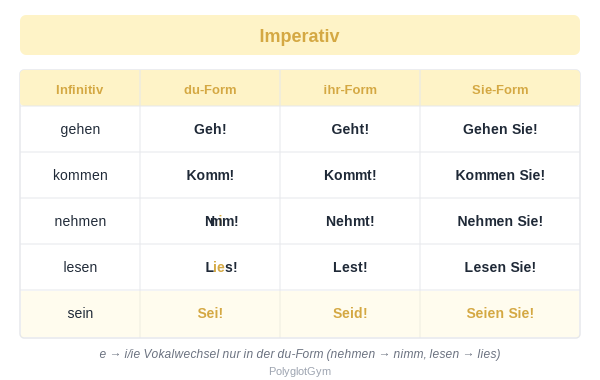
Learners forget to include Sie: Kommen! instead of Kommen Sie! The Sie is mandatory in formal commands.
🇬🇧 English speakers: English speakers may drop 'Sie' since English imperatives have no pronoun: 'Kommen!' instead of 'Kommen Sie!' — the pronoun is mandatory.
Nehmen Sie bitte Platz!
Please take a seat!
Formal command: verb + Sie. Bitte makes it polite.
Gehen Sie geradeaus und dann links.
Go straight ahead and then left.
Giving directions formally: Gehen Sie + direction.
Rufen Sie mich morgen an!
Call me tomorrow!
Separable verb anrufen: an goes to the end.
这个主题的检测还在准备中
问问索菲
在课程中练习
在 A1 课程练习中应用此语法