动词A1
Trennbare Verben
Separable verbs: aufstehen, anfangen, einkaufen
学习目标
Can use separable verbs to describe daily routines
考试技能:写作口语
观察以下示例,你能发现语法规律吗?
Ich stehe jeden Tag um 7 Uhr auf.
I get up at 7 o'clock every day.
Wann fängt der Film an?
When does the movie start?
Kaufst du heute ein?
Are you going shopping today?
注意高亮部分,它们有什么共同点?
English has phrasal verbs like "get up", "give up" and "come along", and the little word can drift away from the verb: "I get the kids up". German has the same idea, but writes the pair as one word in the infinitive (aufstehen, "to get up") and, in a normal sentence, sends the prefix all the way to the end.
| Prefix | Verb | Example sentence |
|---|---|---|
| auf- | aufstehen - to get up | Ich stehe um 7 Uhr auf. |
| an- | anfangen - to begin | Der Kurs fängt um 9 an. |
| ein- | einkaufen - to go shopping | Wir kaufen im Supermarkt ein. |
| mit- | mitkommen - to come along | Kommst du mit? |
| zu- | zuhören - to listen | Hör bitte zu! |
| aus- | ausgehen - to go out | Wir gehen heute Abend aus. |
| fern- | fernsehen - to watch TV | Opa sieht jeden Abend fern. |
The sentence bracket
In a main clause, the conjugated part of the verb takes position 2 and the prefix goes to the very end. Everything else sits inside this bracket, however long it gets: Ich stehe am Wochenende nie vor zehn Uhr auf. English speakers tend to keep the prefix close to the verb, as in *Ich stehe auf um sieben. The prefix waits for the end of the clause.
When the verb stays whole
The prefix stays attached when the verb itself goes to the end: after a modal verb (Ich muss morgen früh aufstehen.), in a subordinate clause (..., weil ich früh aufstehe.) and in the infinitive. In the perfect tense, ge- slips between prefix and stem: Ich bin um sieben aufgestanden. Wir haben eingekauft.
How to recognise them
Separable prefixes are mostly words that also exist on their own, often prepositions or adverbs: an, auf, aus, ein, mit, nach, vor, zu, zurück, fern, los. They carry the stress: AUFstehen, EINkaufen. Compare the inseparable prefixes be-, ver-, er-, which are unstressed and stay put: Ich verstehe, Ich bezahle.
The prefix changes the meaning
The prefix is not decoration. Hören is "to hear", aufhören "to stop", zuhören "to listen". Kommen is "to come", ankommen "to arrive", mitkommen "to come along". Forget the prefix at the end and you have said something else: Ich höre (I hear) is not Ich höre auf (I stop). So listen to the end of a German sentence before you decide what it means.
在 A1 课程练习中应用此语法
练习题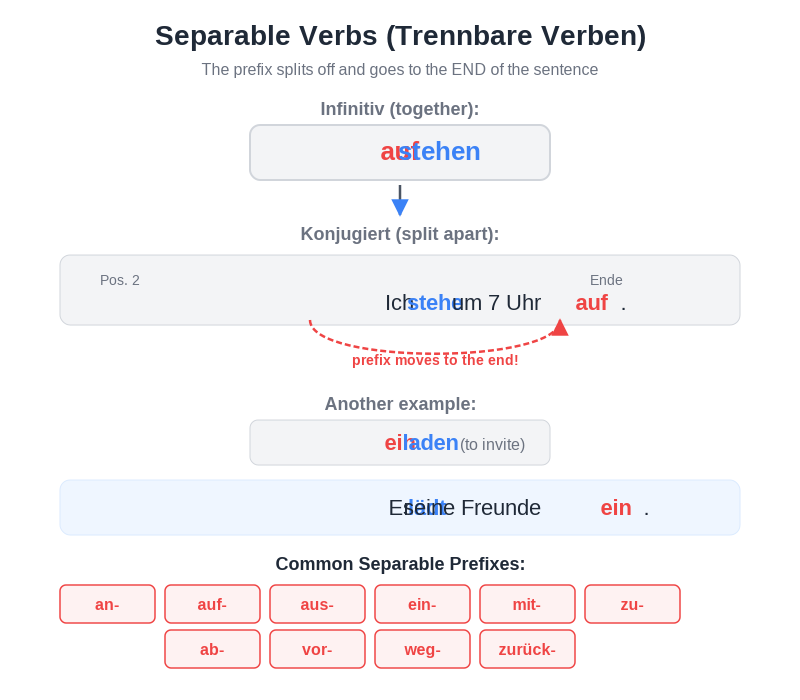
Learners forget to move the prefix to the end: Ich aufstehe instead of Ich stehe auf.
🇬🇧 English speakers: English speakers have no concept of separable verbs and frequently forget to move the prefix to the end: 'Ich aufstehe' instead of 'Ich stehe auf'.
Ich stehe jeden Tag um 7 Uhr auf.
I get up at 7 o'clock every day.
aufstehen: the prefix auf moves to the end of the sentence.
Wann fängt der Film an?
When does the movie start?
anfangen: an goes to the end. Note stem change: a → ä.
Kaufst du heute ein?
Are you going shopping today?
einkaufen: ein goes to the end, even in questions.
这个主题的检测还在准备中
问问索菲
在课程中练习
在 A1 课程练习中应用此语法