动词A1
Perfekt: Einführung
Introduction to past tense with haben + Partizip II
学习目标
Can talk about past events using the perfect tense
考试技能:写作口语
观察以下示例,你能发现语法规律吗?
Ich habe gestern einen Film gesehen.
I watched a movie yesterday.
Wir sind nach Berlin gefahren.
We drove to Berlin.
Hast du gut geschlafen?
Did you sleep well?
注意高亮部分,它们有什么共同点?
The Perfekt is how Germans talk about the past in conversation. Where English says "I watched a film yesterday", a German says Ich habe gestern einen Film gesehen - word for word "I have yesterday a film seen".
That is the first big difference from English. English separates "I saw" (finished, simple past) from "I have seen" (present perfect), and "I have seen it yesterday" is wrong. Spoken German does not draw that line: the Perfekt covers both, and a time word like gestern is perfectly normal with it. In southern Germany, Austria and Switzerland the Perfekt has almost entirely replaced the simple past in speech.
The structure: a bracket again
The Perfekt has two parts: a form of haben or sein in position 2, and the past participle (Partizip II) at the end.
| Position 2 (auxiliary) | Middle | End (participle) | English |
|---|---|---|---|
| Ich habe | gestern Tennis | gespielt. | I played tennis yesterday. |
| Wir haben | das Buch | gelesen. | We read the book. |
| Hast du | gut | geschlafen? | Did you sleep well? |
| Er ist | nach Berlin | gefahren. | He went to Berlin. |
English speakers keep the two verbs together: *Ich habe gespielt Tennis. Send the participle to the end, just as you do with a modal's infinitive.
haben or sein?
| Auxiliary | Used with | Examples |
|---|---|---|
| haben | most verbs, including nearly every verb with a direct object | gemacht, gekauft, gelesen, gegessen |
| sein | movement from A to B, and change of state | gegangen, gefahren, gekommen, aufgestanden |
Rule of thumb: if someone moves from one place to another or turns into something else (einschlafen, aufwachen), use sein; otherwise use haben. Sein and bleiben themselves also take sein: Ich bin zu Hause geblieben.
At A1: you will practice the Perfekt mainly with haben (Ich habe gemacht, er hat gekauft). The verbs with sein are in the table so you recognise them; using them actively comes at A2.
One more tip: sein and haben themselves are usually put in the simple past even in speech - Ich war in Köln, Wir hatten Glück - rather than ich bin gewesen.
在 A1 课程练习中应用此语法
练习题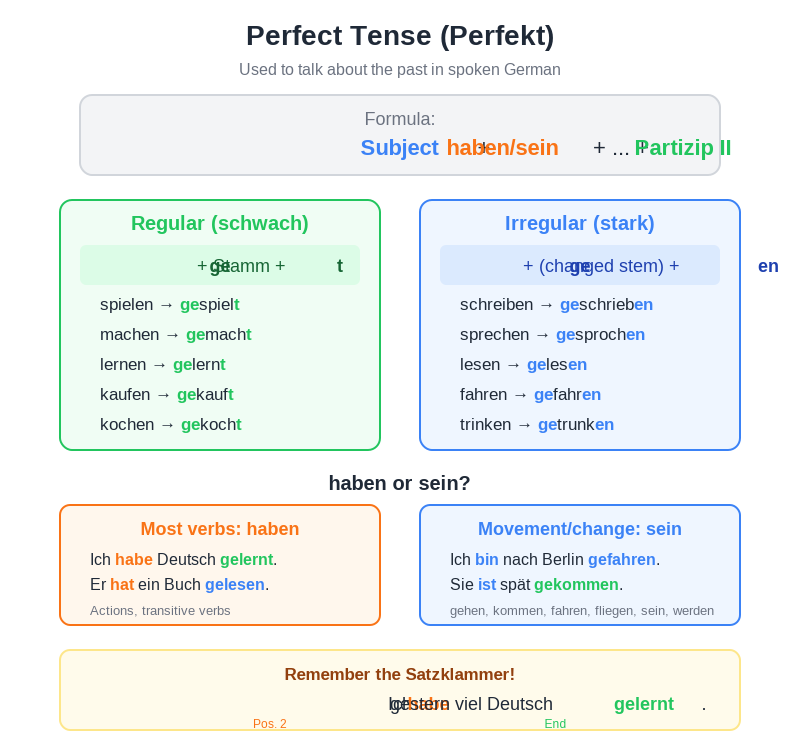
Learners forget to put the Partizip II at the end: Ich habe gespielt Tennis instead of Ich habe Tennis gespielt.
🇬🇧 English speakers: English speakers keep English word order with the participle: 'Ich habe gespielt Tennis' instead of 'Ich habe Tennis gespielt' — the participle must go to the end.
Ich habe gestern einen Film gesehen.
I watched a movie yesterday.
Haben at position 2, gesehen (Partizip II) at the end.
Wir sind nach Berlin gefahren.
We drove to Berlin.
Fahren uses sein (movement verb): sind + gefahren.
Hast du gut geschlafen?
Did you sleep well?
Question: Hast du + rest + geschlafen at the end.
这个主题的检测还在准备中
问问索菲
在课程中练习
在 A1 课程练习中应用此语法