动词A1
Das Verb 'haben'
Conjugation and usage of haben (to have)
学习目标
Can express possession using the verb haben
考试技能:写作口语
观察以下示例,你能发现语法规律吗?
Ich habe einen Bruder.
I have a brother.
Hast du Zeit?
Do you have time?
Er hat keine Kinder.
He has no children.
注意高亮部分,它们有什么共同点?
Haben means "to have", and after sein it is the most important verb in German. It is irregular in two places, du hast and er hat, where the b of the stem disappears.
| Person | Form | Person | Form |
|---|---|---|---|
| ich | habe - I have | wir | haben - we have |
| du | hast - you have | ihr | habt - you (pl.) have |
| er/sie/es | hat - he/she/it has | sie/Sie | haben - they have / you have |
English speakers usually find these easy, because "has" and hat, "hast" (as in old "thou hast") and hast are close relatives. In speech, ich habe is often shortened to ich hab'.
Possession and family
Ich habe einen Bruder und zwei Schwestern. Hast du ein Fahrrad? Wir haben einen Garten. Note einen: the thing you have is the object of the sentence, so it is in the accusative case, and a masculine article changes from ein to einen. Ich habe einen Hund, not *ein Hund.
Hunger, thirst and time
Where English uses "to be", German often uses haben with a noun:
| German | English |
|---|---|
| Ich habe Hunger. | I'm hungry. |
| Ich habe Durst. | I'm thirsty. |
| Ich habe Angst. | I'm afraid. |
| Ich habe Zeit. | I'm free / I have time. |
| Ich habe recht. | I'm right. |
| Ich habe Geburtstag. | It's my birthday. |
Saying Ich bin hungrig is correct but sounds stiff in everyday speech; Ich habe Hunger is what people actually say, for instance outside a Currywurst stand at lunchtime.
But: cold and bored take sein
Body temperature and many feelings work differently. "I'm cold" is Mir ist kalt, literally "to me is cold", with sein and the dative mir. Likewise Mir ist warm / schlecht / langweilig. Ich bin kalt means something else (that you are a cold person), and *Ich habe kalt is not German.
Age takes sein, not haben
Age is said as in English: Ich bin zwanzig Jahre alt. If you speak French, Spanish or Italian, resist the urge to say *Ich habe zwanzig Jahre.
haben as a helper verb
Most verbs form the perfect tense with haben, much like English "have": Ich habe das Buch gelesen. - I have read the book (or simply: I read the book). Wir haben in Dresden Stollen gekauft.
在 A1 课程练习中应用此语法
练习题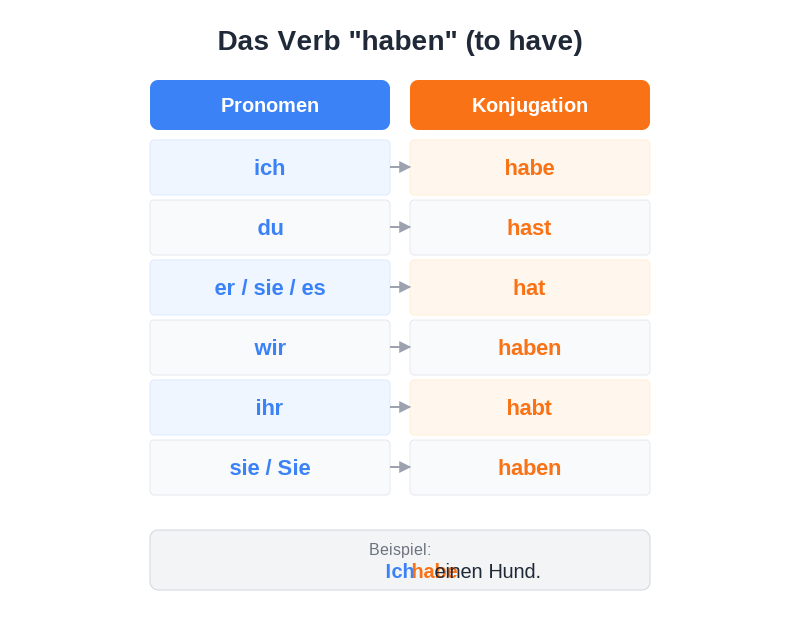
English speakers usually get ich bin 25 Jahre alt right, but translate 'I am cold' word for word as ich bin kalt, which describes a cold personality.
🇬🇧 English speakers: 'Ich bin kalt' means 'I am a cold person'; for feeling cold German says 'mir ist kalt' (dative + sein).
Ich habe einen Bruder.
I have a brother.
Haben takes accusative: ein → einen (masculine).
Hast du Zeit?
Do you have time?
Du hast — note the irregular stem without b.
Er hat keine Kinder.
He has no children.
Haben + kein to negate nouns: keine Kinder.
这个主题的检测还在准备中
问问索菲
在课程中练习
在 A1 课程练习中应用此语法