动词A1
Das Verb 'sein'
Conjugation and usage of sein (to be)
学习目标
Can describe people and things using the verb sein
考试技能:写作口语
观察以下示例,你能发现语法规律吗?
Ich bin Student.
I am a student.
Seid ihr müde?
Are you (all) tired?
Das ist mein Bruder.
That is my brother.
Mir ist kalt.
I'm cold.
注意高亮部分,它们有什么共同点?
Sein is "to be", and like its English counterpart it is completely irregular. Its forms have to be learned by heart, but there are just five different words for six persons, and English speakers find several of them familiar: ist is "is", bin sounds like the "been" of "I have been".
| Person | Form | Person | Form |
|---|---|---|---|
| ich | bin - I am | wir | sind - we are |
| du | bist - you are | ihr | seid - you (pl.) are |
| er/sie/es | ist - he/she/it is | sie/Sie | sind - they are / you are |
Do not confuse ihr seid (you are) with the preposition seit (since). They sound the same, and even native speakers mix them up in writing.
What sein is used for
Name, origin, job and description: Ich bin Anna. Wir sind aus Leipzig. Er ist Lehrer. (no "a" before the job, see the topic on professions) Das Wetter in Hamburg ist oft grau.
Age, however, is said with sein plus alt, much like English: Ich bin zwanzig Jahre alt. Learners who know French or Spanish sometimes say *Ich habe zwanzig Jahre, which is wrong in German.
"I am cold" is "to me is cold"
For many physical and emotional states, German does not say "I am cold". It says "to me it is cold", with the dative pronoun mir and the verb sein:
- Mir ist kalt. - I'm cold.
- Mir ist warm. - I'm warm.
- Mir ist schlecht. - I feel sick.
- Mir ist langweilig. - I'm bored.
- Ihr ist schwindelig. - She's dizzy.
- Das ist mir egal. - I don't care.
The pattern is dative pronoun + ist + adjective. Saying Ich bin kalt is a classic English-speaker mistake: it means your personality is cold, not that you need a jumper. And it is not *Ich habe kalt either, which is how a French speaker might say it.
sein as a helper verb
In the perfect tense, verbs of movement and change use sein where English uses "have": Ich bin nach Salzburg gefahren. - I have driven to Salzburg. Er ist eingeschlafen. - He has fallen asleep.
After sein: the nominative
The noun after sein stays in the nominative, the case of the subject: Das ist ein guter Mann. Compare Ich sehe einen Mann, where the object changes to einen. With sein there is no object, so nothing changes.
sein in other tenses
| Tense | Example | Meaning |
|---|---|---|
| Present | ich bin, du bist, er ist | I am |
| Simple past (Präteritum) | ich war, du warst, er war | I was |
| Perfect (Perfekt) | ich bin gewesen | I have been |
| Past perfect (Plusquamperfekt) | ich war gewesen | I had been |
| Future (Futur I) | ich werde sein | I will be |
In conversation, Germans say ich war far more often than ich bin gewesen: Ich war letztes Jahr in Wien. And if you ever wonder what the dictionary form of bin or ist is: it is sein.
在 A1 课程练习中应用此语法
练习题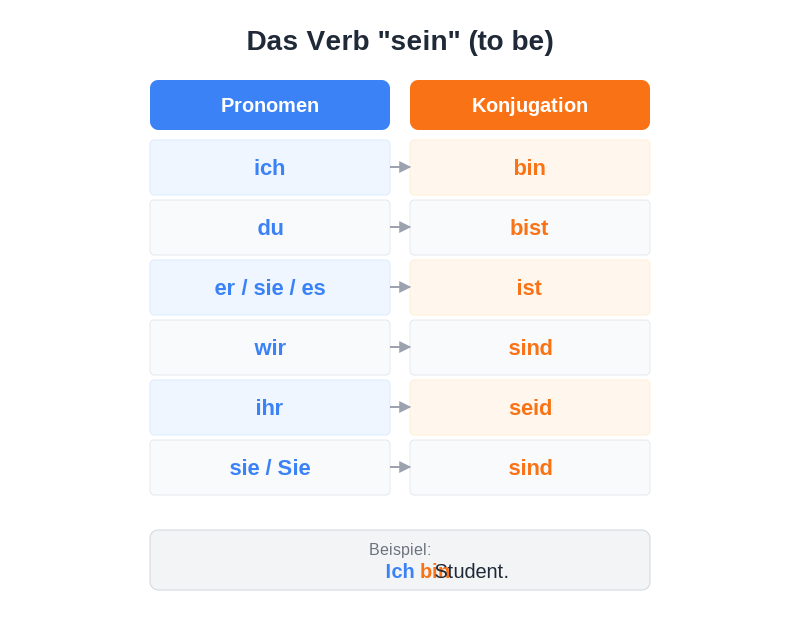
Learners often say ich bin from Germany instead of ich bin aus Deutschland, or forget that sein has no regular pattern at all.
🇬🇧 English speakers: English speakers may add articles with professions: 'Ich bin ein Lehrer' (influenced by 'I am a teacher') instead of 'Ich bin Lehrer'.
Ich bin Student.
I am a student.
No article before professions after sein: Ich bin Student (not ein Student).
Seid ihr müde?
Are you (all) tired?
Ihr seid — the informal plural form of sein.
Das ist mein Bruder.
That is my brother.
Das ist... is used to introduce or point out people and things.
Mir ist kalt.
I'm cold.
Dative + sein for physical states: Mir ist kalt (not Ich habe kalt!). Literally: 'To me is cold.'
Mir ist schlecht. Ich gehe nach Hause.
I feel sick. I'm going home.
Mir ist schlecht — another Dativ + sein idiom for physical/emotional states.
Es ist mir egal.
I don't care.
Es ist mir egal — a common idiomatic expression with Dativ + sein meaning indifference.
这个主题的检测还在准备中
问问索菲
在课程中练习
在 A1 课程练习中应用此语法