动词A2
Reflexive Verben
Verbs with reflexive pronouns referring back to the subject
学习目标
Can use reflexive verbs for daily routines and feelings
考试技能:写作口语
观察以下示例,你能发现语法规律吗?
Ich freue mich auf das Wochenende.
I'm looking forward to the weekend.
Er wäscht sich die Hände.
He washes his hands.
Bitte setzen Sie sich!
Please sit down! (formal)
Ich kann mir das nicht vorstellen.
I can't imagine that.
注意高亮部分,它们有什么共同点?
Reflexive verbs use a pronoun that refers back to the subject. The reflexive pronoun can be accusative or dative.
| Person | Akk. | Dat. |
|---|---|---|
| ich | mich | mir |
| du | dich | dir |
| er/sie/es | sich | sich |
| wir | uns | uns |
| ihr | euch | euch |
| sie/Sie | sich | sich |
Accusative reflexive (no other object): sich freuen, sich setzen, sich ärgern, sich beeilen, sich erinnern.
Dative reflexive (with another accusative object): sich etwas wünschen, sich etwas vorstellen, sich etwas kaufen.
Rule: If the verb already has a direct object, the reflexive is dative. If the reflexive IS the only object, it is usually accusative; a verb that takes the dative keeps it: Ich helfe mir selbst.
在 A2 课程练习中应用此语法
练习题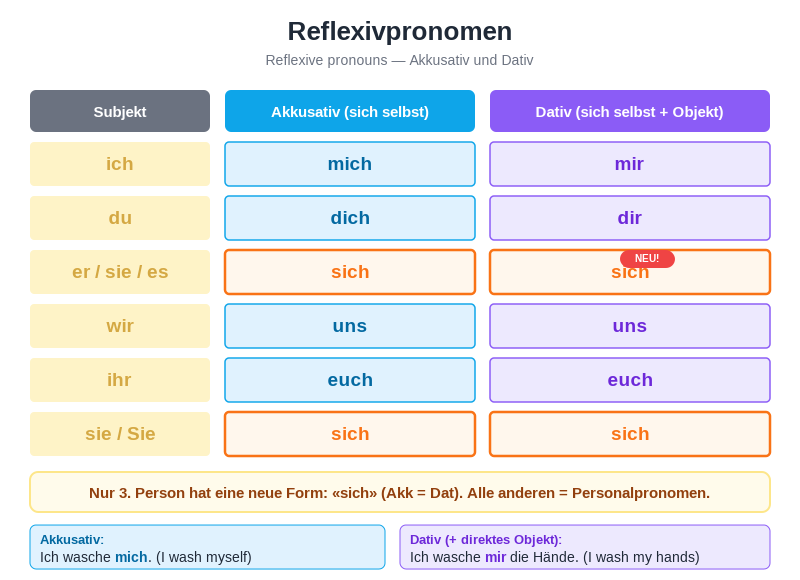
- Omitting the reflexive: ✗ Ich freue → ✓ Ich freue mich.
- Wrong case: ✗ Ich wasche mich die Hände → ✓ Ich wasche mir die Hände.
- Forgetting sich for 3rd person: ✗ Er beeilt ihn → ✓ Er beeilt sich.
Ich freue mich auf das Wochenende.
I'm looking forward to the weekend.
Sich freuen auf + acc. Reflexive mich is accusative.
Er wäscht sich die Hände.
He washes his hands.
Reflexive sich is dative; die Hände is accusative.
Bitte setzen Sie sich!
Please sit down! (formal)
Sich setzen = to sit down.
Ich kann mir das nicht vorstellen.
I can't imagine that.
Sich vorstellen (imagine) takes dative: mir.
Wir müssen uns beeilen.
We have to hurry.
Sich beeilen. Uns is accusative reflexive.
这个主题的检测还在准备中
问问索菲
在课程中练习
在 A2 课程练习中应用此语法