动词A1
Regelmäßige Verben
Regular verb pattern with wohnen, spielen, lernen
学习目标
Can talk about daily activities using regular verbs
考试技能:写作口语
观察以下示例,你能发现语法规律吗?
Ich wohne in Berlin.
I live in Berlin.
Spielst du gern Fußball?
Do you like playing football?
Sie lernen jeden Tag neue Wörter.
They learn new words every day.
注意高亮部分,它们有什么共同点?
Once you can conjugate one regular verb, you can conjugate hundreds. This page drills the pattern with three verbs you will use in your first conversations: wohnen (to live somewhere), spielen (to play) and lernen (to learn).
| Person | wohnen | spielen | lernen |
|---|---|---|---|
| ich | wohne | spiele | lerne |
| du | wohnst | spielst | lernst |
| er/sie/es | wohnt | spielt | lernt |
| wir | wohnen | spielen | lernen |
| ihr | wohnt | spielt | lernt |
| sie/Sie | wohnen | spielen | lernen |
Read the table in pairs and it shrinks: wir and sie/Sie share the infinitive form, er and ihr share the -t. Four distinct endings cover six persons.
Where English speakers slip
- Dropping the ending. In English, "I live" and "you live" are the same word, so learners say *ich wohn or *du wohnen. The ending is not optional in written German: ich wohne, du wohnst. (In casual speech you will hear ich wohn', but write the -e.)
- Adding "do". Spielst du Fußball? is the whole question. There is no German "do": *Machst du spielen Fußball? is wrong.
- Looking for "-ing". Ich lerne Deutsch is "I learn German" and "I am learning German".
wohnen and leben
Wohnen means to live at an address or in a town: Ich wohne in Freiburg, in der Wilhelmstraße. Leben means to be alive, or to live a life somewhere in a wider sense: Meine Oma lebt noch. - My grandma is still alive. For "Where do you live?" Germans ask Wo wohnst du?
More verbs to practise
hören (to hear, listen), kochen (to cook), kaufen (to buy), fragen (to ask), suchen (to look for), brauchen (to need). Try a short sentence with each: Am Samstag kaufe ich auf dem Markt Spargel. Mein Bruder kocht. Wir hören Musik.
在 A1 课程练习中应用此语法
练习题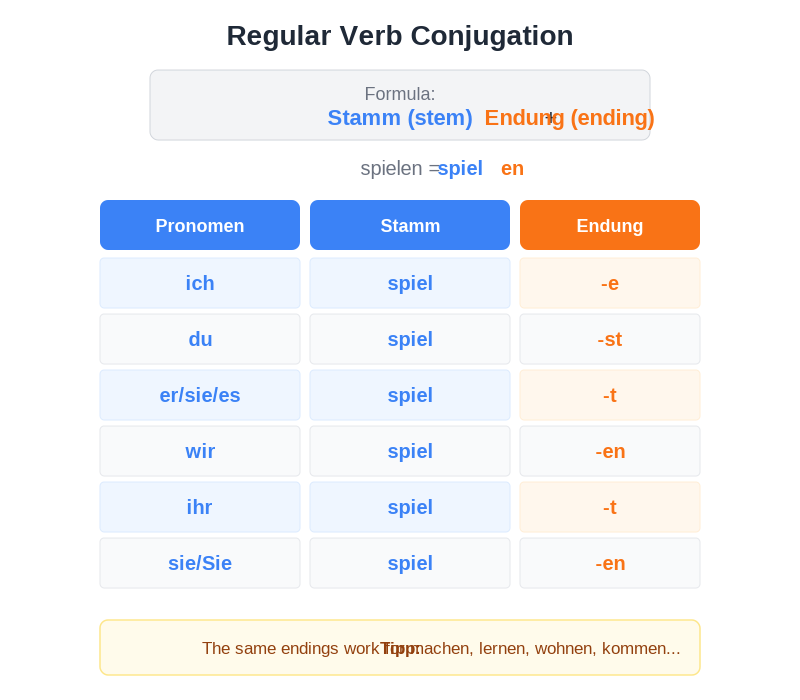
Learners sometimes add an -e- before -st or -t when it is not needed: du spielest instead of du spielst.
🇬🇧 English speakers: English speakers may forget endings entirely since English only has -s for third person, producing 'ich wohne, du wohne, er wohne'.
Ich wohne in Berlin.
I live in Berlin.
wohnen: stem wohn + ending -e for ich.
Spielst du gern Fußball?
Do you like playing football?
spielen: du spielst — the verb comes first in yes/no questions.
Sie lernen jeden Tag neue Wörter.
They learn new words every day.
lernen: sie lernen — third person plural keeps the infinitive form.
这个主题的检测还在准备中
问问索菲
在课程中练习
在 A1 课程练习中应用此语法