动词A1
Modalverb 'müssen'
müssen for obligation and necessity
学习目标
Can express obligation and necessity with müssen
考试技能:写作口语
观察以下示例,你能发现语法规律吗?
Ich muss morgen früh aufstehen.
I have to get up early tomorrow.
Du musst nicht kommen.
You don't have to come.
Wir müssen jetzt los.
We have to go now.
注意高亮部分,它们有什么共同点?
Müssen expresses obligation or necessity: English "must" and "have to" in one verb.
| Person | Form | Person | Form |
|---|---|---|---|
| ich | muss | wir | müssen |
| du | musst | ihr | müsst |
| er/sie/es | muss | sie/Sie | müssen |
As with every modal, ich and er/sie/es share one form without an ending, and the singular drops the umlaut: ich muss, wir müssen. The main verb goes to the end: Ich muss morgen früh aufstehen. Wir müssen jetzt los. - We have to go now (here los stands in for "losgehen").
The big trap: muss nicht is not "must not"
In the positive, "must" and müssen match. In the negative they split, and this trips English speakers up again and again:
| German | English | Meaning |
|---|---|---|
| Du musst nicht kommen. | You don't have to come. | optional - come if you like |
| Du darfst nicht rauchen. | You must not smoke. | forbidden |
Read nicht müssen as "not necessary" and you will not go wrong. To forbid something, switch to dürfen: Hier darf man nicht parken. Compare: Sonntags muss man nicht arbeiten - on Sundays you don't have to work. Im ICE darf man nicht rauchen - you must not smoke on an ICE train.
Everyday müssen
Germans often drop the main verb when it is obvious: Ich muss nach Hause. - I have to go home. And Ich muss mal on its own is the polite way to say you need the toilet.
在 A1 课程练习中应用此语法
练习题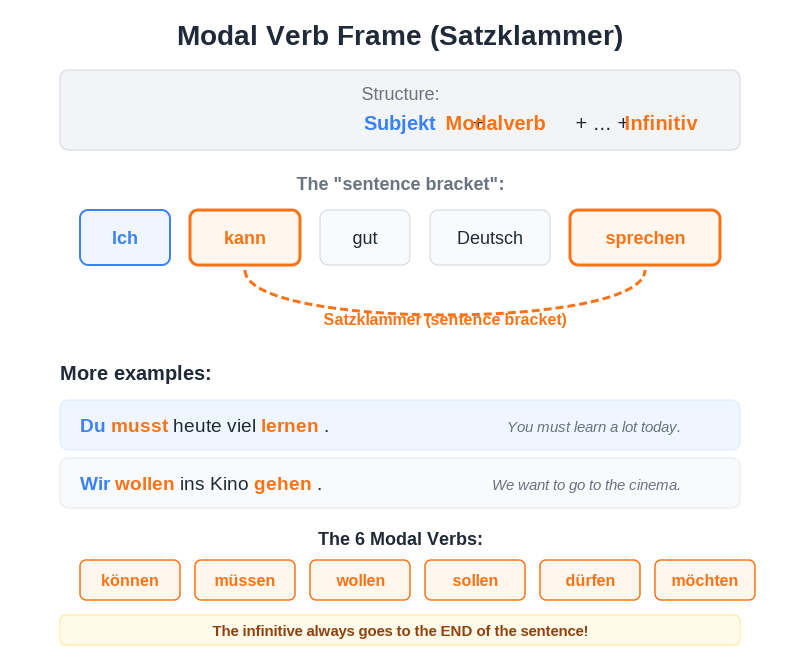
Learners translate 'must not' as muss nicht, but muss nicht means 'don't have to'. Use darf nicht for prohibition.
🇬🇧 English speakers: English speakers translate 'must not' as 'muss nicht' — but 'muss nicht' means 'don't have to'; the correct translation for 'must not' is 'darf nicht'.
Ich muss morgen früh aufstehen.
I have to get up early tomorrow.
Müssen expresses necessity: muss + infinitive at the end.
Du musst nicht kommen.
You don't have to come.
Nicht müssen = don't have to (optional), NOT 'must not'.
Wir müssen jetzt los.
We have to go now.
Losmüssen — colloquial for 'have to leave': los replaces a full infinitive.
这个主题的检测还在准备中
问问索菲
在课程中练习
在 A1 课程练习中应用此语法