Stavba větyB1
Vztažné věty (dativ/předložkové)
Relative clauses with dative and prepositional relative pronouns
Cíl učení
Can form relative clauses with dative and prepositions
Zkouškové dovednosti:ČteníPsaní
Podívejte se na tyto příklady. Dokážete rozpoznat gramatický vzorec?
Der Kollege, dem ich das Buch geliehen habe, ist nett.
The colleague I lent the book to is nice.
Die Stadt, in der ich aufgewachsen bin, ist klein.
The city I grew up in is small.
Die Freunde, mit denen ich reise, kommen aus Berlin.
The friends I travel with come from Berlin.
Das Restaurant, in dem wir gestern waren, war toll.
The restaurant we were at yesterday was great.
Zaměřte se na zvýrazněné části. Co mají společného?
Building on nom./acc. relative clauses, we add dative and prepositional relative pronouns.
| Maskulin | Feminin | Neutrum | Plural | |
|---|---|---|---|---|
| Dativ | dem | der | dem | denen |
Dative: when pronoun = indirect object or dative verb: Der Mann, dem ich geholfen habe.
Preposition + pronoun: Preposition comes before the pronoun: Die Stadt, in der ich wohne.
Special plural dative: denen (not den): Die Leute, denen ich es erzählt habe.
Použijte tuto gramatiku ve cvičeních kurzu B1
Procvičovací cvičení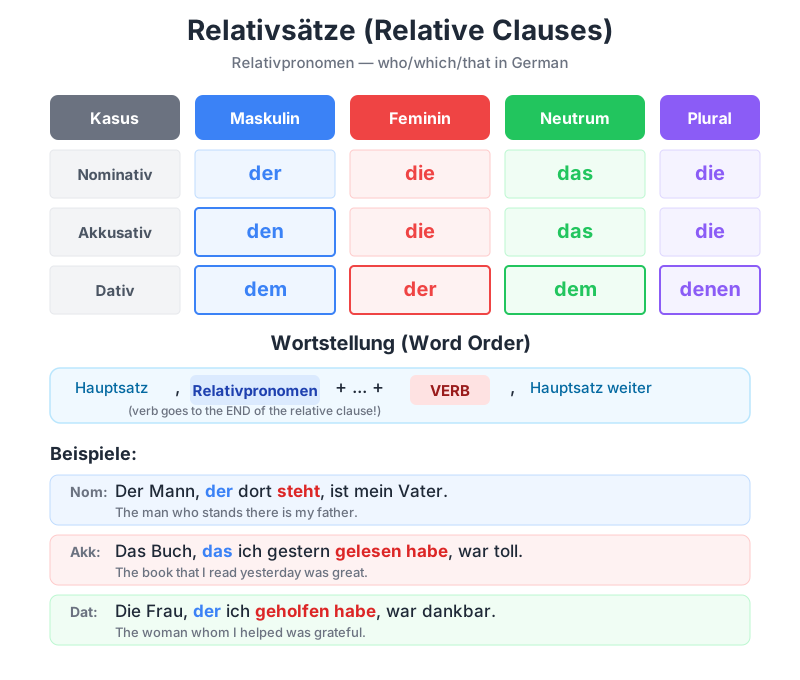
- Wrong plural dative: ✗ Die Kinder, den ich helfe → ✓ Die Kinder, denen ich helfe.
- Preposition position: ✗ Die Stadt, die ich in wohne → ✓ Die Stadt, in der ich wohne.
- Confusing der: Die Frau, der ich helfe — der is fem. dative, not masc. nom.
Časté chyby
Verb not in second position in main clause
Count positions: element 1 + VERB + rest. The verb is always second.
Wrong word order in subordinate clause
In subordinate clauses (weil, dass, wenn...) the verb goes to the END
Wrong connector or connector type used
Review: coordinating (und, aber, oder) vs subordinating (weil, dass, wenn) conjunctions
Der Kollege, dem ich das Buch geliehen habe, ist nett.
The colleague I lent the book to is nice.
Dem = dative. Kollege is masculine.
Die Stadt, in der ich aufgewachsen bin, ist klein.
The city I grew up in is small.
In + dative: Stadt is feminine → in der.
Die Freunde, mit denen ich reise, kommen aus Berlin.
The friends I travel with come from Berlin.
Mit + dative plural: denen.
Das Restaurant, in dem wir gestern waren, war toll.
The restaurant we were at yesterday was great.
In + dative: Restaurant is neuter → in dem.
Procvičit v kurzu
Použijte tuto gramatiku ve cvičeních kurzu B1