Imperativ (du-Form)
Informal commands: Geh! Nimm! Lies!
Can give informal commands to friends and family
Look at these examples. Can you spot the grammar pattern?
Komm schnell!
Come quickly!
Lies das Buch!
Read the book!
Steh bitte auf!
Please stand up!
Pay attention to the highlighted parts. What do they have in common?
Der informelle Imperativ (du-Form) wird für Aufforderungen an Freunde, Familie und Kinder verwendet.
Bildung: Verbstamm ohne -st und ohne du:
| Infinitiv | du-Form | Imperativ |
|---|---|---|
| kommen | du kommst | Komm! |
| gehen | du gehst | Geh! |
| warten | du wartest | Warte! |
| machen | du machst | Mach! |
Stammvokalwechsel e→i/ie: Die Änderung bleibt: Nimm! (nehmen), Lies! (lesen), Sprich! (sprechen).
Aber a→ä fällt weg: Fahr! (fahren, nicht Fähr), Schlaf! (schlafen).
Trennbare Verben: Steh auf! Mach das Licht an! Ruf mich an!
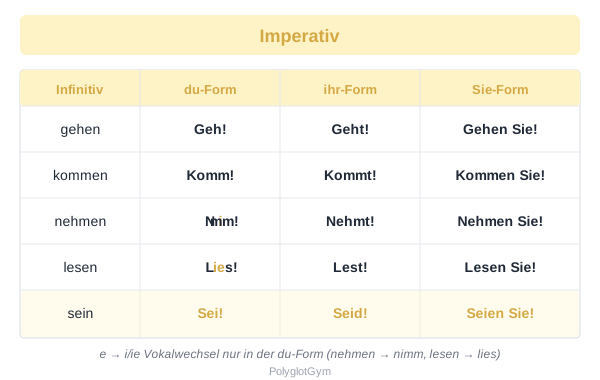
Common Error Patterns
Incorrect verb ending for the subject
Review verb conjugation tables and practice matching endings to pronouns
Forgot stem vowel change in irregular verbs
Practice stem-changing verbs (e→i, e→ie, a→ä) with flashcards
Verb placed in wrong position
Remember: V2 in main clauses, verb-final in subordinate clauses
Komm schnell!
Come quickly!
Regular verb: stem komm without du or ending -st.
Lies das Buch!
Read the book!
lesen: e → ie change is kept in the imperative: Lies!
Steh bitte auf!
Please stand up!
Separable verb aufstehen: Steh...auf! Prefix goes to the end.
Prerequisites
Also in Verbs
Leads to
Practice in course
Apply this grammar in A1 course exercises