动词C1
Indirekte Rede der Presse
Journalistic Konjunktiv I in full: backshift-free reporting, würde/Konjunktiv II as replacement when forms collide, tense layers (sei gewesen)
学习目标
I can report in journalistic Konjunktiv I with the full replacement cascade.
考试技能:阅读写作
观察以下示例,你能发现语法规律吗?
Der Trainer erklärte, die Mannschaft sei müde, aber man werde am Sonntag dennoch gewinnen.
The coach explained that the team was tired but that they would still win on Sunday.
Die Anwohner sagten, sie hätten den Lärm seit Wochen gemeldet, doch niemand habe reagiert.
The residents said they had been reporting the noise for weeks, but nobody had responded.
注意高亮部分,它们有什么共同点?
English reports speech by shifting tenses and adding "said that": "She said she was satisfied." German newspapers and broadcasters use a special verb form instead, Konjunktiv I, which marks a sentence as someone else's words. Read a Tagesschau report or any quality paper and whole paragraphs run in Konjunktiv I, with no quotation marks needed: the verb form tells you who is speaking.
| Direct speech | Reported (press style) | English |
|---|---|---|
| „Ich bin zufrieden." | Sie sagte, sie sei zufrieden. | She said she was satisfied. |
| „Wir haben Zeit." | Sie sagten, sie hätten Zeit. | They said they had time. |
| „Ich war dort." | Er sagte, er sei dort gewesen. | He said he had been there. |
| „Wir werden prüfen." | Man werde prüfen. | They would look into it. |
| „Kommen Sie morgen!" | Sie solle morgen kommen. | She was to come the next day. |
No tense shift
English backshifts: "I am" becomes "she was". German press style does not. The tense of the reported sentence stays what it was in the original, and Konjunktiv I does the marking. Present stays present (bin → sei), the future stays future (werden → werde), and all past tenses collapse into one compound form: sei gewesen, habe gesagt, sei gekommen.
The replacement rule
Konjunktiv I is distinct from the indicative mainly in the third person singular (er habe, er komme, er sei) and across the board with sein. Where it is identical to the indicative - sie haben, wir kommen - the marking is invisible, so German switches to Konjunktiv II: sie hätten, wir kämen. If the Konjunktiv II form is rare or sounds stilted (sie hülfen, sie stürben), the würde-form steps in: sie würden helfen.
Distance, not doubt
Konjunktiv I does not say the journalist disbelieves the statement. It says: these are the speaker's words, not mine. Der Trainer erklärte, die Mannschaft sei müde, aber man werde am Sonntag dennoch gewinnen reports the coach without endorsing or questioning him. Doubt is added with other means: angeblich, soll/will (Er will nichts gewusst haben), or a Konjunktiv II where a Konjunktiv I would do.
Mistakes English speakers make
- Using the indicative (Sie sagte, sie ist zufrieden). Fine in conversation, but in a written report it loses the distance signal.
- Backshifting into the past by English habit: *Sie sagte, sie war zufrieden where the original was present.
- Keeping a Konjunktiv I that looks like the indicative: Die Minister sagten, sie haben keine Zeit (fine in conversation, ambiguous in a report) → sie hätten keine Zeit.
在 C1 课程练习中应用此语法
练习题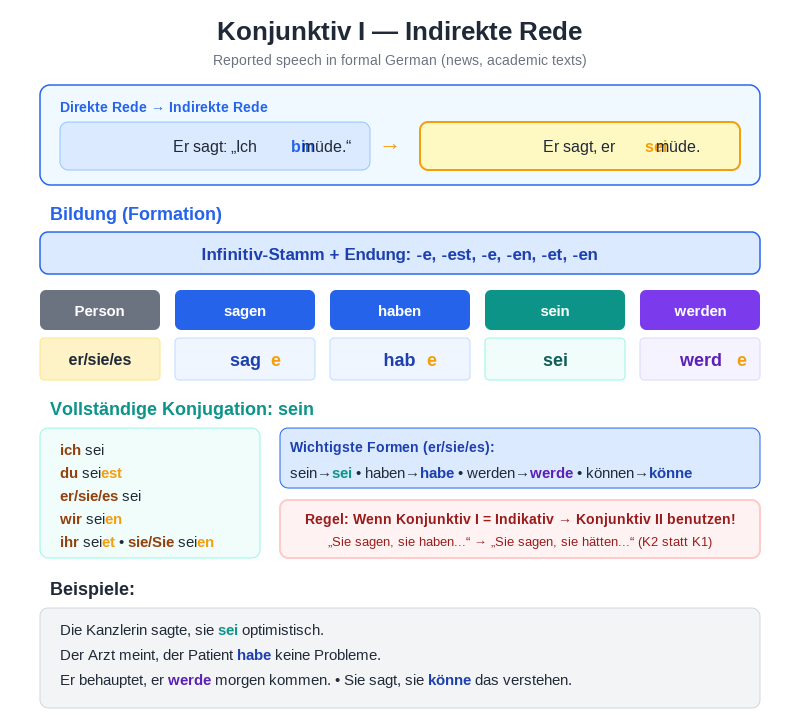
- Indicative in reported speech: drops the distance signal
- K I kept where it equals indicative: sie haben → sie hätten
Der Trainer erklärte, die Mannschaft sei müde, aber man werde am Sonntag dennoch gewinnen.
The coach explained that the team was tired but that they would still win on Sunday.
sei + werde: present and future reported.
Die Anwohner sagten, sie hätten den Lärm seit Wochen gemeldet, doch niemand habe reagiert.
The residents said they had been reporting the noise for weeks, but nobody had responded.
hätten (collision fix) + habe reagiert (K I past).
这个主题的检测还在准备中
问问索菲
在课程中练习
在 C1 课程练习中应用此语法