VerbsA2
Prefixes on verbs of motion
Spatial prefixes on motion verbs: při- (arrival), od- (leaving), vy- (out), pře- (across), v- (in) — and why prefixed forms are perfective
Learning Goal
I can express arriving, leaving, crossing and entering with prefixed motion verbs in past and future.
Exam Skills:CCE A2 · ListeningCCE A2 · Speaking
Look at these examples. Can you spot the grammar pattern?
Rychlík z Ostravy přijede na třetí kolej.
The express from Ostrava will arrive on track three.
Odešla z kanceláře v pět a vyšla na Petřín.
She left the office at five and walked up Petřín hill.
Přejděte most a vejděte do první hospody.
Cross the bridge and enter the first pub.
Pay attention to the highlighted parts. What do they have in common?
English builds direction with a little word after the verb: come in, go out, walk across. Czech puts that little word in front, as a prefix, on jít (on foot) or jet (by vehicle). The prefix also makes the verb perfective: one completed movement.
The main prefixes
| Prefix | Direction | On foot | By vehicle |
|---|---|---|---|
| při- | arriving | přijít | přijet |
| od- | leaving | odejít | odjet |
| v(e)- | in | vejít | vjet |
| vy- | out; up | vyjít | vyjet |
| pře- | across | přejít | přejet |
| ob(e)- | around | obejít | objet |
| do- | as far as | dojít | dojet |
| s(e)- | down | sejít | sjet |
A few more you will hear daily: projít (go through; a walk is a procházka), zajít (pop in: Zajdeme na pivo?), and ujet, which gives the most Czech of excuses: Ujela mi tramvaj, I missed the tram.
Perfective, so no budu
Because these verbs are perfective, their present-tense forms mean the future: přijdu (I'll come), přijedu (I'll arrive), odejdu (I'll leave). *Budu přijít does not exist. The past is regular: přišel, odešel, přijel, odjel.
For the ongoing or repeated movement each verb has an imperfective partner built on -cházet (foot) or -jíždět (vehicle): přicházet, odcházet, vycházet; přijíždět, odjíždět, vyjíždět. On the platform you hear Vlak z Brna právě přijíždí. One of these has its own life: dojíždět means to commute. Dojíždím do Prahy z Kladna.
Where English speakers slip
- "Come" is not always přijít. A train, a bus or a friend driving over přijede: Rychlík z Ostravy přijede v deset. If you walk, přijdu.
- Adding a preposition English does not need. Czech often repeats the direction: vejít do domu, vyjít z domu, odejít z práce.
- Reading vy- as only "out". With a hill it means up: Vyšli jsme na Petřín.
Some prefixed verbs carry a second meaning worth knowing early: přejet stanici is to ride past your stop, and sejít se is to meet. Prague's classic meeting point is under the statue of St Wenceslas: Sejdeme se u koně.
Apply this grammar in A2 course exercises
Practice Exercises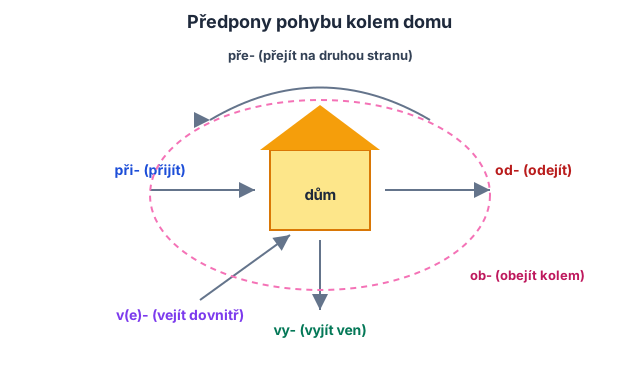
- Prefixed perfectives with budu: *budu přijít → přijdu
- A foot verb for a vehicle: Vlak *přijde → přijede (trains arrive with -jet)
- od- vs vy-: odejít z práce (leave) × vyjít z domu (step out)
Common Error Patterns
Wrong prefix for the direction
Map prefixes spatially: při=to, od=from, vy=out, pře=across
budu + prefixed perfective
Prefixed motion verbs are perfective: přijdu, odjedu
Rychlík z Ostravy přijede na třetí kolej.
The express from Ostrava will arrive on track three.
přijede: arrival by vehicle, perfective future.
Odešla z kanceláře v pět a vyšla na Petřín.
She left the office at five and walked up Petřín hill.
od- = away from, vy- = up/out: two directions, one sentence.
Přejděte most a vejděte do první hospody.
Cross the bridge and enter the first pub.
pře- = across, v(e)- = into; imperatives of prefixed verbs.
The check for this topic is still being prepared
Ask Sofi
Ready-made hints are free
Practice in course
Apply this grammar in A2 course exercises
Frequently asked questions
- When do you use Prefixes on verbs of motion?
- English builds direction with a little word after the verb: come in , go out , walk across . Czech puts that little word in front , as a prefix, on jít (on foot) or jet (by vehicle). The prefix also makes the verb perfective : one completed movement.
- How do you form Prefixes on verbs of motion?
- A few more you will hear daily: projít (go through; a walk is a procházka ), zajít (pop in: Zajdeme na pivo? ), and ujet , which gives the most Czech of excuses: Ujela mi tramvaj , I missed the tram. Because these verbs are perfective, their present-tense forms mean the future: přijdu (I'll come), přijedu (I'll arrive), odejdu (I'll leave). *Budu přijít does not exist. The past is regular: přišel, odešel, přijel, odjel . For the ongoing or repeated movement each verb has an imperfective partner built on -cházet (foot) or -jíždět (vehicle): přicházet, odcházet, vycházet; přijíždět, odjíždět, vyjíždět . On the platform you hear Vlak z Brna právě přijíždí.
- What are common mistakes with Prefixes on verbs of motion?
- Prefixed perfectives with budu: *budu přijít → přijdu A foot verb for a vehicle: Vlak *přijde → přijede (trains arrive with -jet) od- vs vy-: odejít z práce (leave) × vyjít z domu (step out)